China’s solar manufacturing sector offers several mature technologies, but the “best” choice depends on climate, roof space, budget, and project life. IRENA’s Renewable Capacity Statistics 2024 reported that China added about 217 gigawatts of solar capacity in 2023. That scale reflects strong manufacturing depth, yet it does not make every module suitable for every site.
What is the difference between solar panel types? Monocrystalline panels usually provide higher power density, which helps on small rooftops with limited usable area. Polycrystalline panels once offered a lower-cost alternative, but their market position has weakened as advanced mono technologies became more affordable. TOPCon modules can improve efficiency and energy yield, especially where roof space is constrained. Heterojunction, or HJT, panels often offer strong temperature performance and attractive low-light behavior. Thin-film modules remain useful for selected lightweight or large-area applications, although their efficiency is generally lower.
The Fraunhofer ISE Photovoltaics Report 2024 shows how commercial module efficiency has continued rising, with leading silicon technologies moving beyond older mainstream levels. NREL’s Best Research-Cell Efficiencies chart also confirms the rapid progress of tandem and crystalline-silicon research. Still, laboratory records are not rooftop results. A hot warehouse roof, coastal humidity, dust, and partial shading can change the practical ranking.
This guide compares China’s main panel types through efficiency, degradation, temperature coefficient, warranty terms, and manufacturing quality. Datasheets can look perfect. Real projects are messier. Buyers should verify independent testing, bankability, certifications, and installer experience before choosing a module. No single panel wins everywhere.
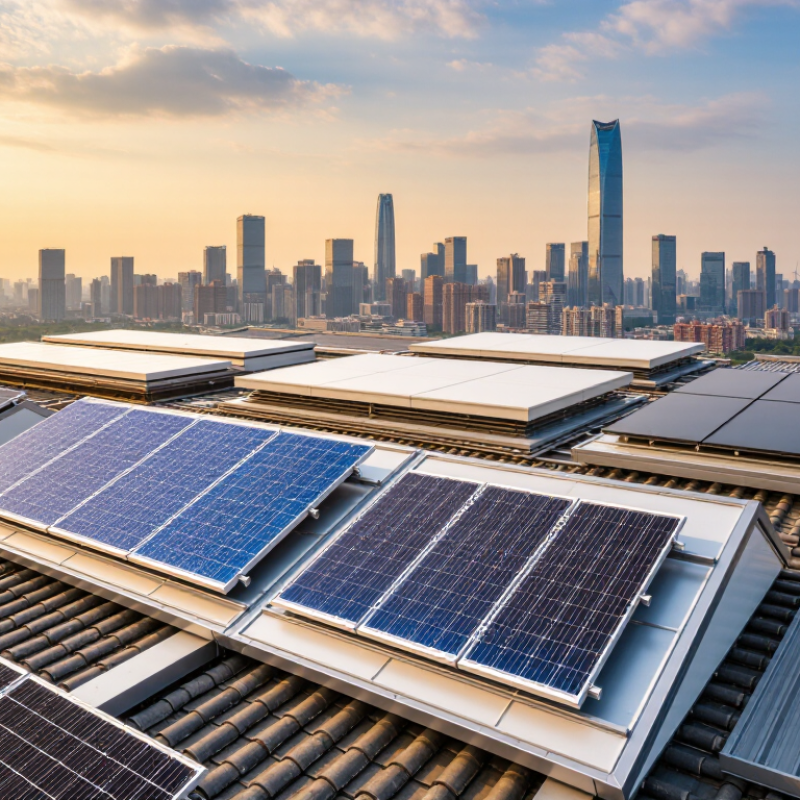
China’s solar market is moving from PERC toward n-type technologies. The International Technology Roadmap for Photovoltaic (ITRPV) 2024 report identifies TOPCon as the fastest-growing mainstream cell design. PERC remains widely installed because its production lines are mature and affordable. However, it usually offers lower efficiency and weaker long-term upgrade potential.
TOPCon adds a passivated contact layer, reducing electronic losses. It delivers strong efficiency, good bifacial performance, and better hot-weather behavior. HJT combines crystalline silicon with thin-film layers. Its temperature coefficient is attractive in deserts and warm coastal regions. The trade-off is more demanding equipment and process control. Higher manufacturing complexity still matters.
Back-contact cells move metal contacts to the rear surface. The front becomes cleaner, which can improve light capture and visual appearance. Fraunhofer ISE’s Photovoltaics Report 2024 records laboratory efficiencies above 26% for leading TOPCon, HJT, and back-contact cells. Commercial modules remain lower. That gap deserves attention. A factory datasheet cannot replace field measurements.
In practical projects, roof area favors high-efficiency back-contact or HJT modules. Large utility sites may prefer TOPCon’s balance of yield, cost, and supply availability. PERC can still make sense for budget-sensitive replacements. The choice is rarely perfect. Dust, heat, installation quality, and degradation assumptions can change the result. Industry forecasts are useful, but local operating data should challenge them.
China’s best solar panel types depend on efficiency, durability, roof space, and local climate. Mono PERC panels commonly deliver about 20–23% module efficiency, according to Fraunhofer ISE’s Photovoltaics Report. Their single-crystal structure helps produce more power from each square meter. That matters on compact urban roofs. Less roof area is wasted.
NREL’s PV Lifetime Project reports an average annual degradation near 0.35% for many well-performing crystalline-silicon systems. At that rate, a panel could retain roughly 91.6% of its initial output after 25 years. The number looks reassuring. It is not a promise. Heat, humidity, dust, shading, and poor ventilation can reduce real production faster. Field conditions are rarely perfect.
During site checks, installers should inspect roof orientation, rear airflow, cable connections, and nearby shadows. A clean laboratory rating cannot describe every roof. The IEA PVPS Task 13 reports that degradation varies significantly between climates and installation practices. Mono PERC also has a practical weakness: its performance may fall during extreme heat, despite strong annual energy yield. Buyers should compare temperature coefficients, warranty terms, and independent test data. Efficiency alone can hide expensive compromises.
China offers several solar panel types, but TOPCon is gaining attention for its balance of efficiency and energy yield. According to Fraunhofer ISE, TOPCon modules can reach about 22–24% efficiency and approximately 80% bifaciality. This means the rear side may produce nearly 80% of the front-side response under suitable light conditions.
More power is possible.
In practical projects, TOPCon performs best when the installation allows reflected light to reach the module’s back. Bright gravel, white membranes, and elevated mounting can improve rear-side gains. However, the result depends on spacing, ground reflectivity, shading, temperature, and system design. A laboratory figure should not be treated as a guaranteed field output. I have seen project estimates become too optimistic when these details were ignored. That is worth questioning.
Tips: Compare temperature coefficients, warranty terms, degradation rates, and real operating data. Check whether the site has enough rear clearance for bifacial performance. Ask for independent test evidence, not only sales claims. TOPCon may cost more than older cell designs, but its higher efficiency can reduce land use and balance-of-system pressure. Still, efficiency alone does not decide value. Installation quality matters.
China Best Solar Panel Types: What Is the Difference?
Heterojunction technology, or HJT, combines crystalline silicon with thin amorphous-silicon layers. Its typical commercial efficiency reaches about 22–24%. Fraunhofer ISE’s Photovoltaics Report 2024 places high-efficiency silicon modules within this competitive range. The International Technology Roadmap for Photovoltaics also identifies heterojunction as a major route for higher module performance.
Temperature behavior is HJT’s practical advantage. Its coefficient is about −0.24%/°C. If a module reaches 65°C, its temperature rises 40°C above the 25°C rating condition. Theoretical power loss is therefore about 9.6%. A conventional module with a −0.35%/°C coefficient could lose roughly 14% under the same conditions. That difference matters on dark rooftops, metal structures, and poorly ventilated arrays. Small numbers become visible energy.
The result is not automatically better in every project. Roof orientation, shading, installation spacing, and inverter loading still control yearly output. NREL’s photovoltaic performance research shows that operating temperature strongly affects real-world generation. HJT also needs careful handling because its thin structures can be less forgiving during transport and installation. I would not judge panels by efficiency alone. A 24% module installed under shade may produce less than a 22% module with cleaner exposure. Field monitoring remains necessary, and published coefficients can differ slightly between datasheets.
Among China’s leading solar panel types, back-contact modules stand out for premium rooftops with limited space. Their electrical contacts sit behind the solar cells, leaving the front surface less interrupted. This design can improve light capture and support efficiencies of up to approximately 24%, depending on the product, test conditions, and installation.
A practical rooftop assessment should examine usable area, roof direction, shading, and local temperature. When space is tight, higher efficiency may produce more electricity from each square metre. For example, a narrow townhouse roof could fit more capacity without expanding the array. Back-contact panels also offer a clean, uniform appearance, which matters for visible residential roofs. Still, efficiency figures are not the whole story.
Heat, dust, inverter quality, mounting, and cable losses affect real-world output. Independent test data and recognized safety certifications deserve careful review. I would not choose a panel from its headline number alone. That is an easy mistake. A slightly less efficient module with stronger temperature performance may deliver better annual energy in a hot region. Installation quality remains critical, too. Even an advanced panel can underperform when rows are poorly spaced or shading is ignored. Premium back-contact technology is powerful, but its higher cost needs to match the roof’s actual constraints.
Back-contact technology can reach approximately 24% efficiency in premium rooftop applications.
The figures represent approximate upper-end commercial module efficiencies and are intended for technology comparison. Actual performance varies by cell design, module format, production year, temperature coefficient, and installation conditions.
Mono PERC panels commonly provide about 20–23% module efficiency. Their single-crystal structure uses limited roof space efficiently. Details matter.
With approximately 0.35% annual degradation, it could retain about 91.6% of its initial output. This is an estimate, not a promise.
Heat, humidity, dust, shading, and poor ventilation can lower production. A dusty panel under partial shade may perform far below its laboratory rating.
Often, yes. They can produce more power from each square metre, leaving less roof area unused. Roof direction still matters.
They should check roof orientation, rear airflow, cable connections, and nearby shadows. Row spacing deserves attention too.
Back-contact modules can reach approximately 24% efficiency under suitable test conditions. Their contacts sit behind the cells, leaving the front surface less interrupted.
Higher efficiency can provide more electricity from limited space. A narrow townhouse roof may fit greater capacity without expanding the array.
No. Temperature performance, dust, inverter quality, mounting, cable losses, and cost also affect yearly output. I might still choose a slightly less efficient panel in a hot region. The headline number can mislead.
What is the difference between solar panel types? The main difference lies in their cell structure, efficiency, energy yield, temperature performance, and cost. Mono PERC panels typically deliver around 20–23% efficiency and have an annual degradation rate of approximately 0.35%, making them a practical choice for many residential and commercial systems. TOPCon technology can reach about 22–24% efficiency and offers roughly 80% bifaciality, allowing panels to generate additional power from reflected light on the rear side.
HJT panels also achieve around 22–24% efficiency and perform well in hot environments because their temperature coefficient is about −0.24% per degree Celsius. Back-contact panels can reach up to approximately 24% efficiency, with a clean appearance and strong suitability for premium rooftop installations. Overall, the best option depends on available space, climate, budget, appearance preferences, and the importance of long-term energy production.

Stove Solar