When considering solar energy, many homeowners ask, "How to calculate how many solar panels I need?" This is a crucial question. Knowing the right number of panels can optimize energy efficiency and reduce costs. Accurate calculations ensure you harness the right amount of solar power for your specific needs.
To begin, understanding your energy consumption is essential. Start by reviewing your electricity bills. Look at your monthly and annual usage. It's important to know your average daily use in kilowatt-hours (kWh). Various factors impact this number, such as household size, appliances, and seasonal changes. Without this data, you may overestimate or underestimate your needs.
Next, consider the solar panel output. Different panels offer varying efficiencies and power outputs. Location also significantly affects production due to sunlight availability. This aspect often requires local knowledge. You may face challenges with shading and orientation. Each situation is unique, and reflection on these factors can lead to better decisions. Effective calculations are not just about numbers; they involve thoughtful consideration of personal circumstances.
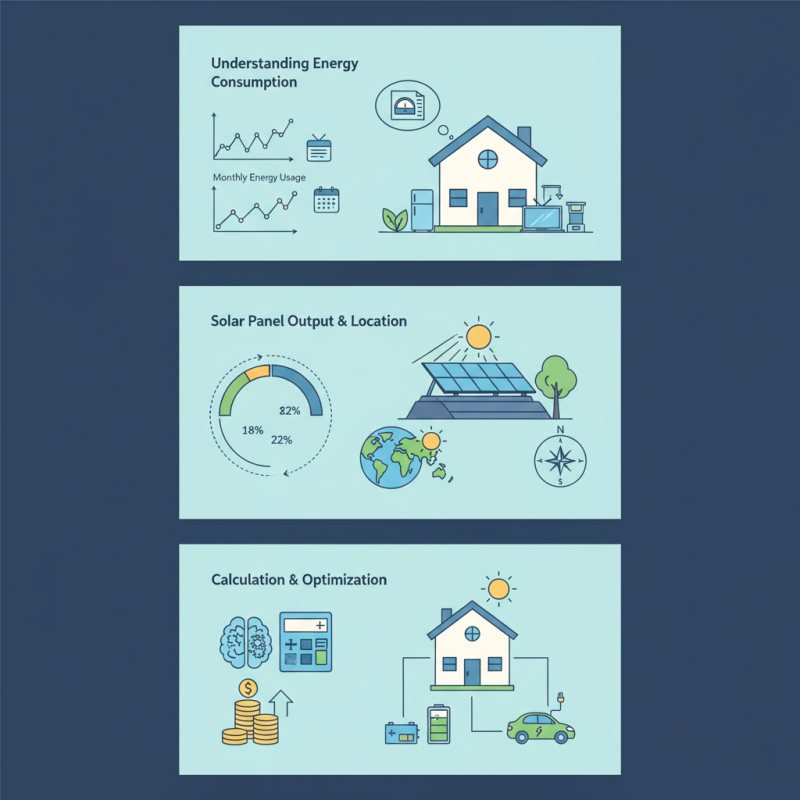
Calculating the number of solar panels you need starts with understanding your energy consumption. Knowing how much energy you use monthly is crucial. The average American household consumes about 877 kWh per month, according to the U.S. Energy Information Administration. This figure can vary significantly based on factors such as home size, climate, and personal habits.
One effective way to estimate your solar needs is to review past utility bills. Look closely at your energy usage patterns. Identify peak usage times and consider how your lifestyle impacts energy consumption. For instance, running air conditioning and heating can increase demand significantly.
Tips: Track your daily energy use for at least a month. Use energy-efficient appliances to reduce consumption. This can lower the number of panels needed.
Another useful method is to calculate your home's square footage and energy efficiency. Homes that are well-insulated typically require less energy. Keeping in mind that not all solar panels produce the same energy can help. According to the National Renewable Energy Laboratory, average solar panel output ranges from 300W to 400W. This variability means you'll need to adjust calculations based on the panel type and your area’s sunlight availability.
When evaluating solar panel output and efficiency, it's essential to understand how these factors impact your energy needs. A standard solar panel generates about 300 watts per hour under optimal conditions. However, efficiency can vary significantly. For residential systems, the average efficiency ranges from 15% to 22%. This means that not all sunlight is converted into usable electricity.
Consider your daily energy consumption. The average American household uses around 877 kWh per month. Dividing this by the average daily solar output, which is approximately 4-5 hours of peak sunlight, allows for better calculation of how many panels you would need. If you install panels with 20% efficiency, you might require up to 20 panels to meet your household's energy needs.
Notably, factors such as roof orientation and shading will also affect output. Even slight inefficiencies in panel orientation can lead to discrepancies in production. It's crucial to assess these variables before installation. Engaging with a professional can help clarify concerns and optimize panel placement for maximum efficiency.
When calculating the total solar panel requirements for your energy needs, start with understanding your average energy consumption. Look at your electricity bills. Determine the total kilowatt-hours (kWh) you use in a month. This number is crucial for setting your goals.
Next, you'll need to consider the amount of sunlight in your area. Sunlight hours vary by location. Use local solar data to find out how many peak sunlight hours you get each day. This information helps estimate how many panels you'll need to produce the required energy.
Tips: Calculate the wattage of the solar panels you plan to use. For instance, if each panel has a capacity of 300 watts, divide your monthly kWh need by the daily sunlight hours to understand how many panels are necessary.
Adjust your calculations based on your roof space and shading issues. Sometimes, ideal panel positioning is not possible. Evaluate your options and be flexible. There might be a need to compromise on the number of panels based on practical limitations.
| Household Monthly Energy Consumption (kWh) | Average Solar Panel Output (kWh per Panel per Day) | Number of Panels Required | Estimated Solar Panel Area Needed (sq ft) |
|---|---|---|---|
| 600 | 1.5 | 12 | 240 |
| 800 | 1.5 | 16 | 320 |
| 1200 | 1.5 | 24 | 480 |
| 1500 | 1.5 | 30 | 600 |
| 2000 | 1.5 | 40 | 800 |
Assessing available roof space is crucial when planning for solar panel installation. Not all roofs are suitable for solar panels. It is essential to evaluate how much space you have and the orientation of your roof. Ideally, south-facing roofs receive the most sunlight. However, east and west also provide excellent solar energy.
Think about obstacles like chimneys or trees. They can cast shadows, reducing the efficiency of solar panels. Measure your roof's dimensions accurately. Calculate the area that can be used effectively. Take note of the pitch of your roof, as steeper roofs may require different panel arrangements.
It’s important to confront potential limitations. Some homes have complicated roof structures. This could lead to insufficient space for the desired number of panels. If your roof space is limited, you might need to explore ground-mounted solar options or even a solar community program. Overall, understanding your roof's characteristics and limitations can guide you in making an informed decision.
When calculating the number of solar panels needed, local climate plays a crucial role. Different regions receive varying amounts of sunlight throughout the year. For instance, areas with frequent overcast skies will generate less solar energy than those in sunnier climates. This variation significantly impacts panel efficiency and energy output.
Sunlight availability is also influenced by seasons. In winter, days are shorter and often cloudy. This seasonal change reduces the energy a solar panel can produce. A careful assessment of average daily sunlight hours in your area is vital. Use tools like solar insolation charts for precise data. Understanding the average kilowatt-hours produced per panel under local conditions will help you make informed decisions.
While calculating, don’t rely solely on theoretical maximums. Real-world conditions often lead to lower performance than expected. Additionally, shading from trees or nearby buildings can further reduce output. Reflect on how these factors will affect your setup. Accurate calculations will ensure your solar system meets your energy needs efficiently.
This chart illustrates the average daily sunlight hours for each month. To determine the number of solar panels needed, consider the sunlight availability in your location alongside your energy usage.
: Check your electricity bills for total kilowatt-hours used in a month. This is essential for planning.
Investigate local solar data. Peak sunlight hours vary, impacting the number of panels needed.
Divide your monthly kWh need by daily sunlight hours. Factor in the wattage of your solar panels.
Available roof space decides how many panels you can install. Not all roofs are suitable for solar panels.
Look for shadows cast by chimneys or trees. These can reduce your solar panels' efficiency.
South-facing roofs are best for sunlight. East and west can also be beneficial.
Consider ground-mounted solar options or join a solar community program. Compromises may be necessary.
Steeper roofs may require different panel arrangements. Complicated structures might limit installation options.
Be flexible and evaluate alternatives. You might need to adjust the number of panels installed.
Yes, accurate measurements help you understand how much of your roof can effectively hold solar panels.
To determine how to calculate how many solar panels I need, start by understanding your energy consumption and needs. It’s essential to analyze your average electricity usage over a year, which helps in estimating the amount of energy you want to generate with solar panels. Next, evaluate the output and efficiency of different solar panels, as this significantly influences how many panels will be required to meet your energy goals.
Once you grasp your energy needs and solar panel capabilities, calculate the total number of panels required. This involves dividing your total energy requirement by the expected output of a single panel. Additionally, assess your available roof space for installation, as it directly impacts how many panels can be installed. Finally, consider local climate conditions and sunlight availability to ensure optimal energy production throughout the year. This comprehensive approach will help you accurately determine the number of solar panels needed for your unique situation.

Stove Solar